The Cash Sales feature in QNE Optimum is used to record a sale when payment is received immediately at the time of the transaction. This is commonly used by cashiers, accountants, and finance staff when customers pay instantly using cash, bank transfer, or other direct payment methods.
Unlike a credit sale, a Cash Sale does not create an Accounts Receivable balance, because the payment is collected at the same time the sale is recorded.
Recording a Cash Sale updates the sales revenue, selected cash or bank account, and any applicable tax in a single transaction, helping keep financial records accurate and up to date.
Prerequisites
Customer record exists, if applicable.
Inventory items or service items have been created.
Cash or bank accounts are configured.
Pricing and tax codes are configured, if applicable.
The user has permission to record Cash Sales.
Scenario:
A business sells office supplies to a regular customer who pays immediately at the time of purchase.
Instead of issuing a sales invoice and recording the payment separately, the accountant records the transaction directly as a Cash Sale.
By using the Cash Sales function in QNE Optimum, the system automatically:
Records the sales revenue
Updates the selected cash or bank account
Applies applicable taxes such as VAT
This allows the business to record completed sales transactions quickly while keeping financial records accurate.
Procedure 1: Recording a Cash Sale
In the Navigation Pane, go to Sales > Cash Sales.
Note: If the Quick Create icon is enabled (the highlighted button in the red box), selecting Cash Sales opens the new Cash Sales transaction form. Otherwise, the Cash Sales List opens.
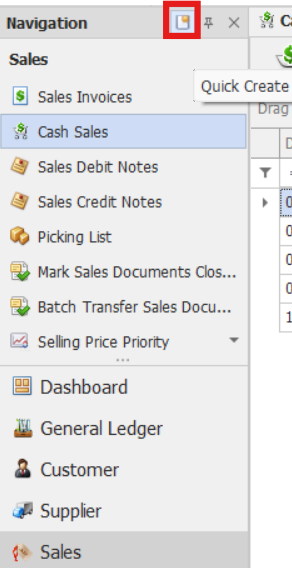
From there, select the New button to create a new Cash Sales transaction.

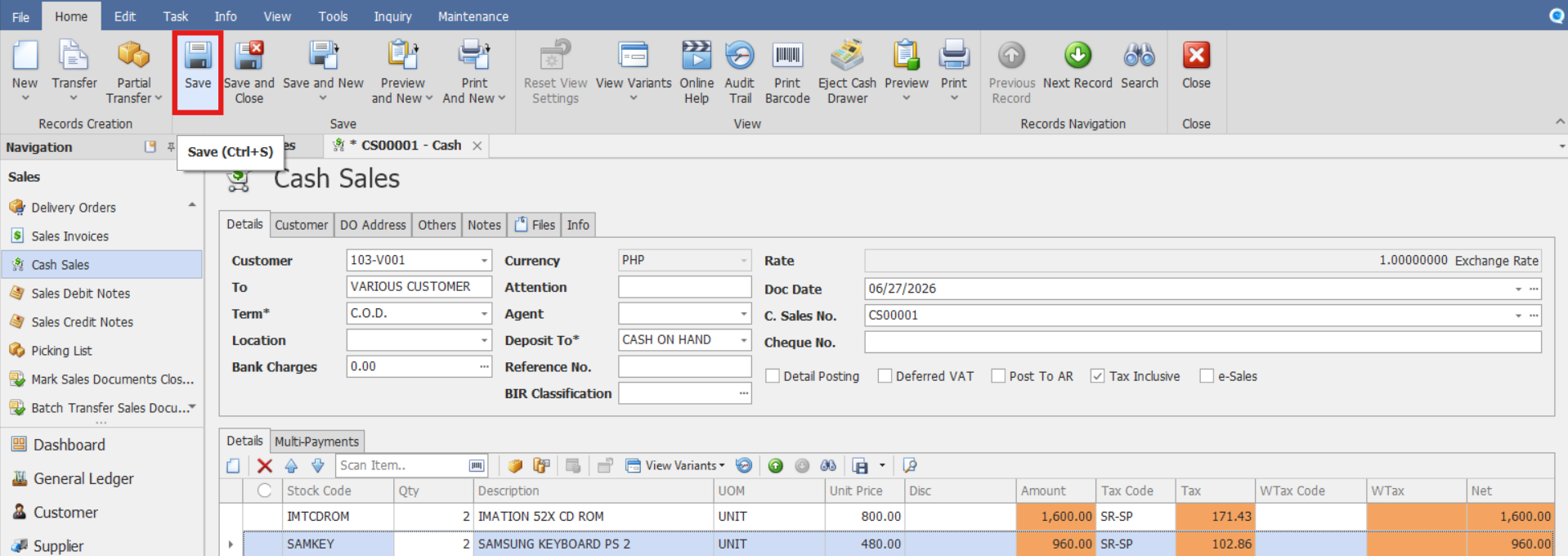
Complete the required fields in the cash sales header.
Customer – Select the customer making the purchase. This may be left as a walk-in customer, depending on company settings.
Currency – Displays the transaction currency and exchange rate. Update the exchange rate if required.
Location – Warehouse, branch, or business location associated with the transaction.
Attention – Name of the customer representative or contact person, if applicable.
Agent - Salesperson or account manager responsible for the transaction.
Deposit To - Select the cash account, petty cash fund, or bank account where the payment received will be deposited (e.g., Cash on Hand).
Project - Project code associated with the cash sale, if the sale is project-related.
Reference No. - Internal reference number used for tracking purposes, if applicable.
C. Sales No. - Unique Cash Sales document number assigned by the system.
Doc Date – Date the Cash Sale is created or issued.
Cheque No. – Enter the cheque number if the customer pays by cheque.
Tax Inclusive – Enable if prices include tax.
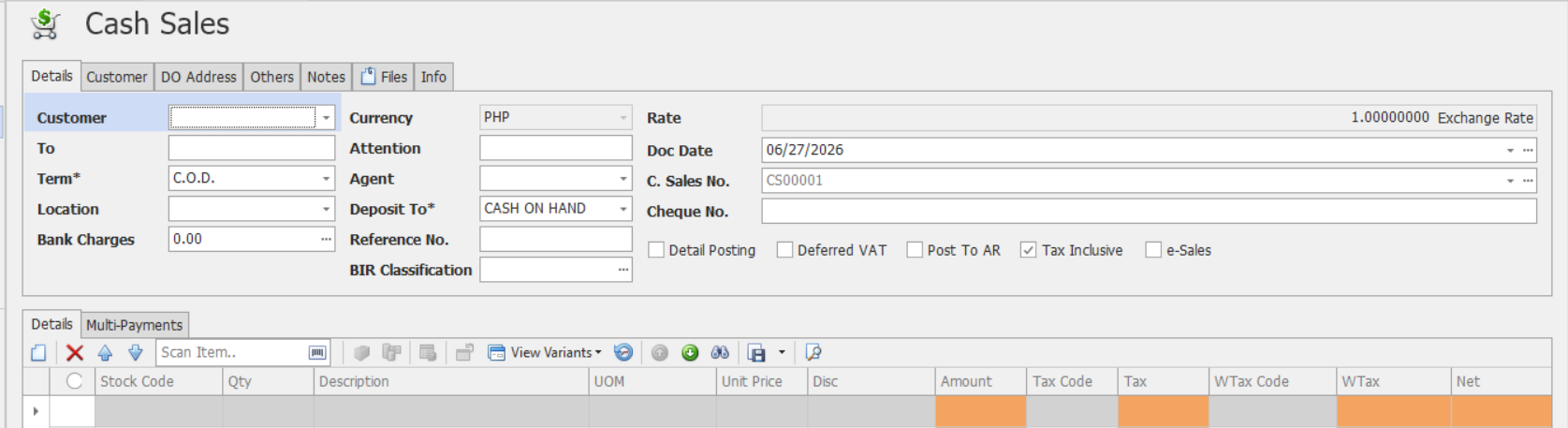
In the Details section, enter the item information
Stock Code – Stock code of the item.
Description – Automatically populated with the stock name once the Stock code is selected.
F.Desc – Additional details about the item if needed.
QTY – Quantity of the item or service being billed.
UOM - Unit of Measure (e.g., pcs, boxes, liters).
Unit Price - Selling price per unit.
Disc – Any Discount applied.
Stock Location - Warehouse, branch, or business location associated with the transaction.
Tax Code - Tax code assigned to the cash sales item, if applicable.
WTAX Code - Withholding tax code assigned to the cash sales item, if applicable.
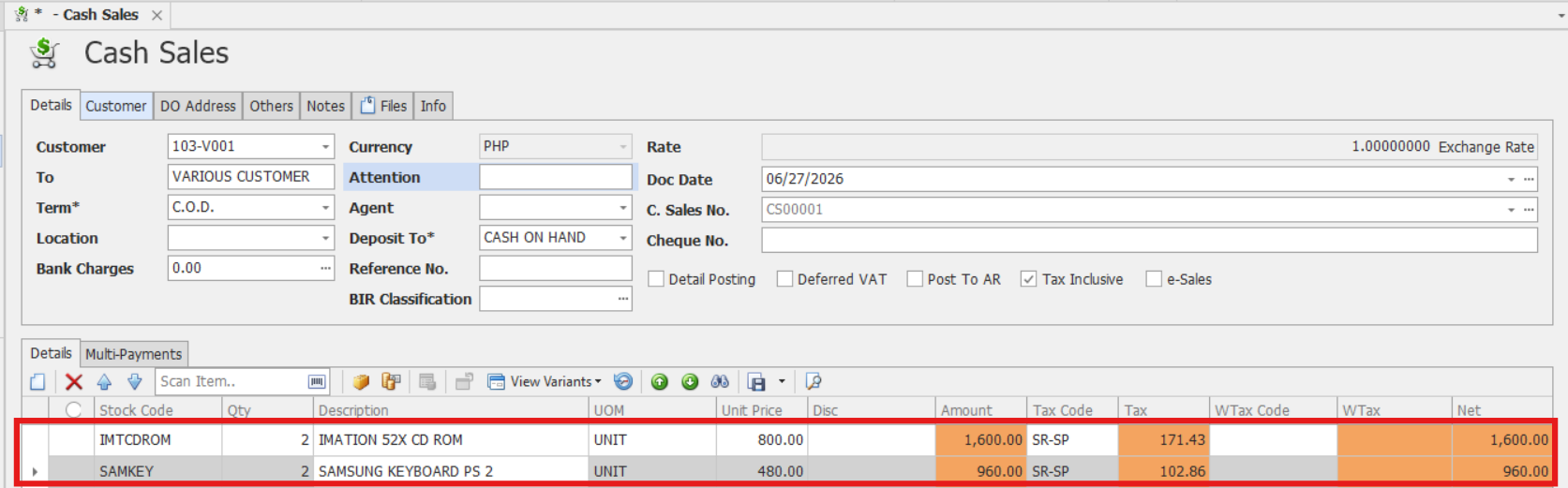
Confirm that the totals are calculated correctly and reflect all adjustments. Then proceed by clicking Save.
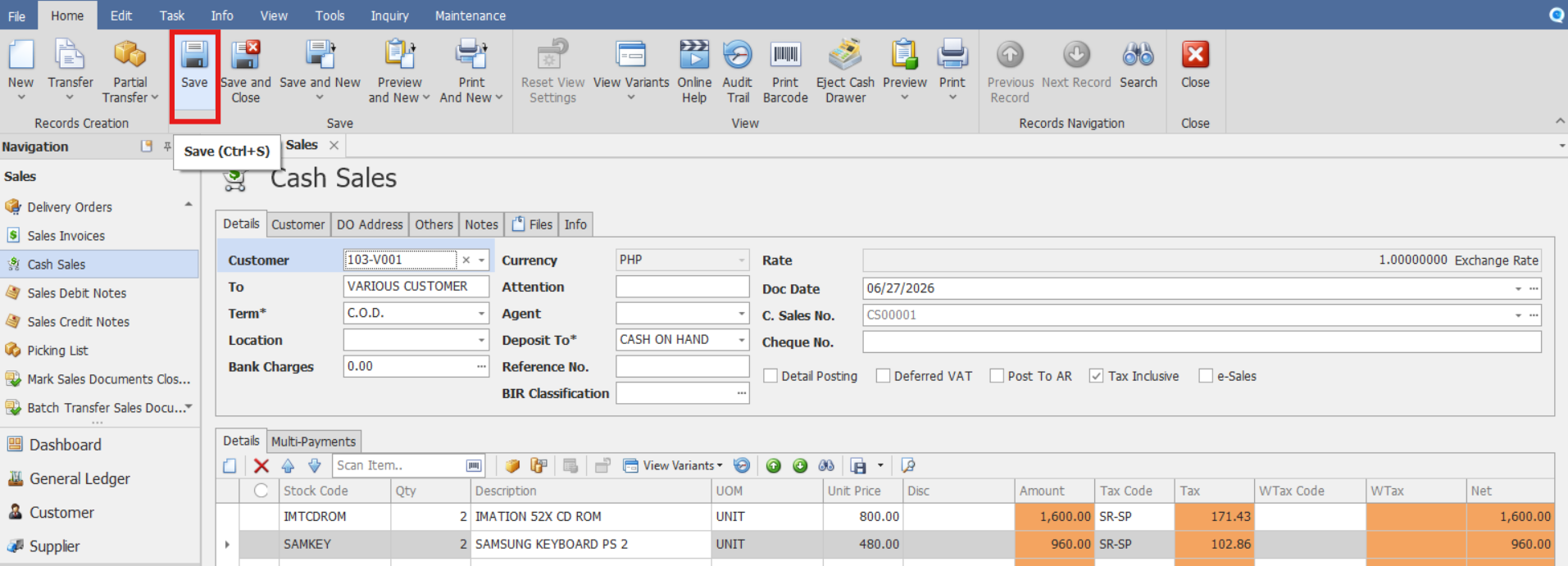
Optional Steps:
The Others and Notes tabs can be used to enter additional remarks or references related to the transaction.

The Files tab can be used to attach supporting documents from your workstation.

The Info tab displays:
document creation timestamp,
user who created the document,
print history information.

Procedure 2: Validation of Recorded Cash Sales
After saving the transaction, verify that:
The cash sale is saved successfully.
The cash sales number is generated or displayed correctly.
The totals reflect the entered pricing, discounts, and taxes.
Verify that the Cash Sale appears in the Cash Sales List.
Procedure 3: Editing a Cash Sale
Go to Sales > Cash Sales, then select the Doc # of the Cash Sales that you want to update.

Once opened, make the required changes, then click Save.
Procedure 4: Deleting a Cash Sale
In the Cash Sales List View, identify the document you wish to delete. Hover your cursor over the document and right-click on it. Then click Delete to remove the transaction.

Verify that the Cash Sale no longer appears in the Cash Sales List.
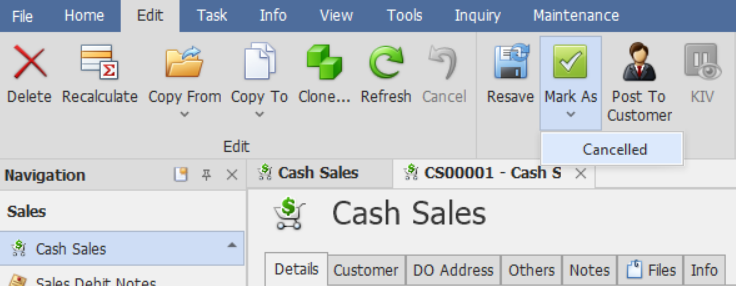
Preferred Method: If the Cash Sale is no longer required, click Cancel instead. This preserves the transaction history while marking it as inactive.
Application:
Cash Sales can be used to:
Immediate Payment Sales
A customer purchases office supplies and pays immediately. The cashier records the transaction as a Cash Sale so that revenue and cash balances are updated at once.Same-Day Customer Payments
A regular customer places an order and pays immediately through bank transfer. The accountant records the sale as a Cash Sale instead of creating a credit invoice.Counter or Retail Sales to Registered Customers
A business sells products directly to a registered customer at the counter. Since payment is received immediately, the transaction is recorded as a Cash Sale.Direct Service Payments
A service provider completes a job and receives payment on the same day. The transaction is recorded as a Cash Sale to capture the income and payment in one step.
Important Notes:
Editing and Deleting Transactions: Editing and deletion permissions may be restricted based on system configuration, organizational policy, or applicable regulatory requirements (such as CAS approval, where applicable). Ensure modifications and deletions follow your organization's internal policies and applicable regulatory requirements.
System Scope: QNE Optimum
Was this article helpful?
That’s Great!
Thank you for your feedback
Sorry! We couldn't be helpful
Thank you for your feedback
Feedback sent
We appreciate your effort and will try to fix the article