Journal Entries in QNE Optimum are used to record accounting transactions directly in the General Ledger when a transaction is not generated automatically through another module. They provide a method for recording adjustments, accruals, reclassifications, opening balances, corrections, and other accounting entries that require direct posting to ledger accounts.
This function is typically used by accountants, finance personnel, bookkeepers, and system administrators responsible for maintaining the organization's financial records.
Creating accurate journal entries supports reliable General Ledger maintenance, financial reporting, and account reconciliation.
Prerequisites
Relevant General Ledger accounts have been created.
Users have permission to create and post Journal Entries.
Required tax codes have been configured, if applicable.
Supporting documents or accounting schedules are available for the transaction being recorded.
Scenario:
At month-end, the accounting department needs to record an accrued expense that has not yet been invoiced by the supplier.
Since the transaction is not generated through the Purchases or Supplier Module, a Journal Entry is created to record the expense and the corresponding liability in the General Ledger.
Procedure 1: Recording a Journal Entry
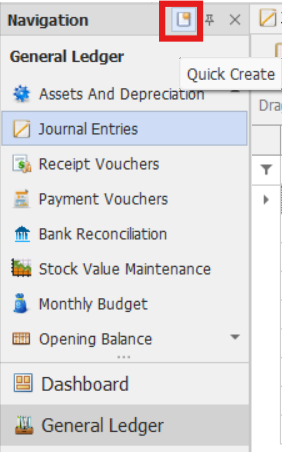
Navigate to General Ledger > Journal Entries,
Note: If the Quick Create Icon (the one inside the red box) is highlighted, clicking Journal Entries will immediately redirect you to the new Journal Entries transaction form. If the Quick Create Icon is not highlighted, you will be directed to the Journal Entries Listing instead.
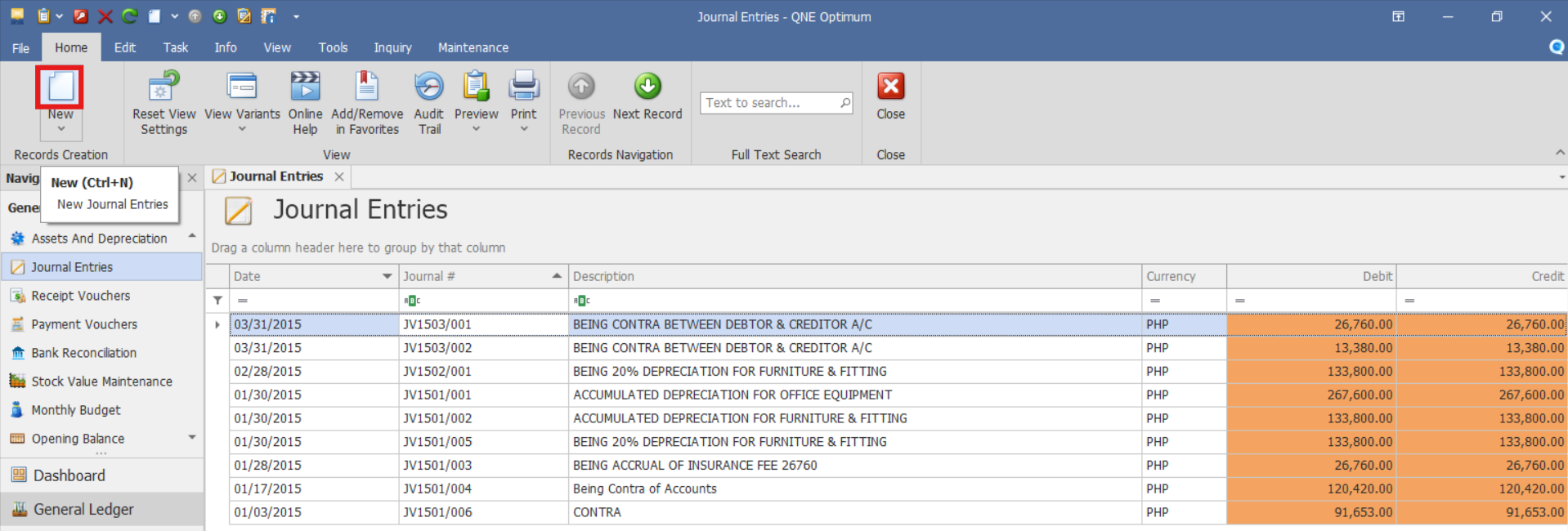
From there, select the New button to create a new Journal Entry transaction.
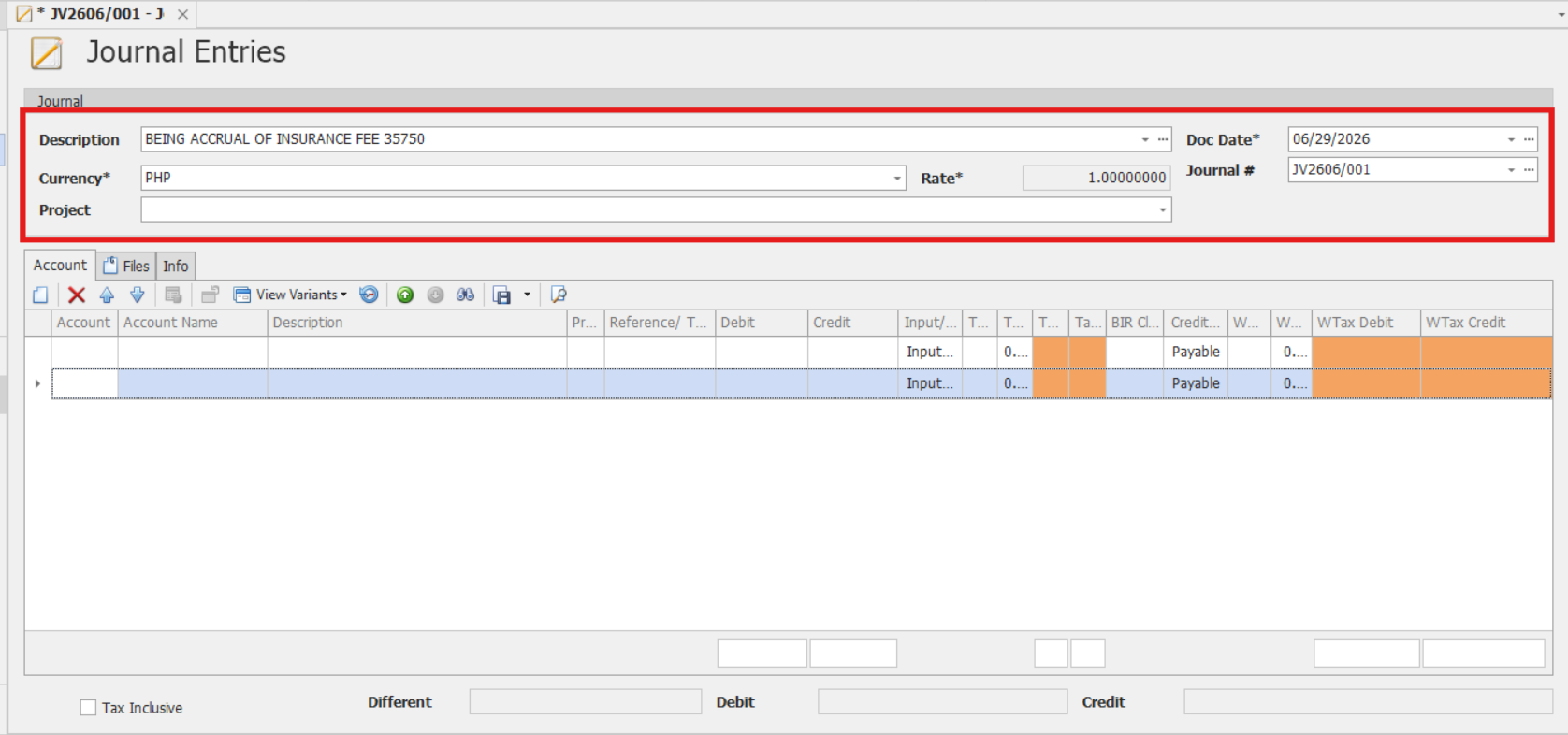
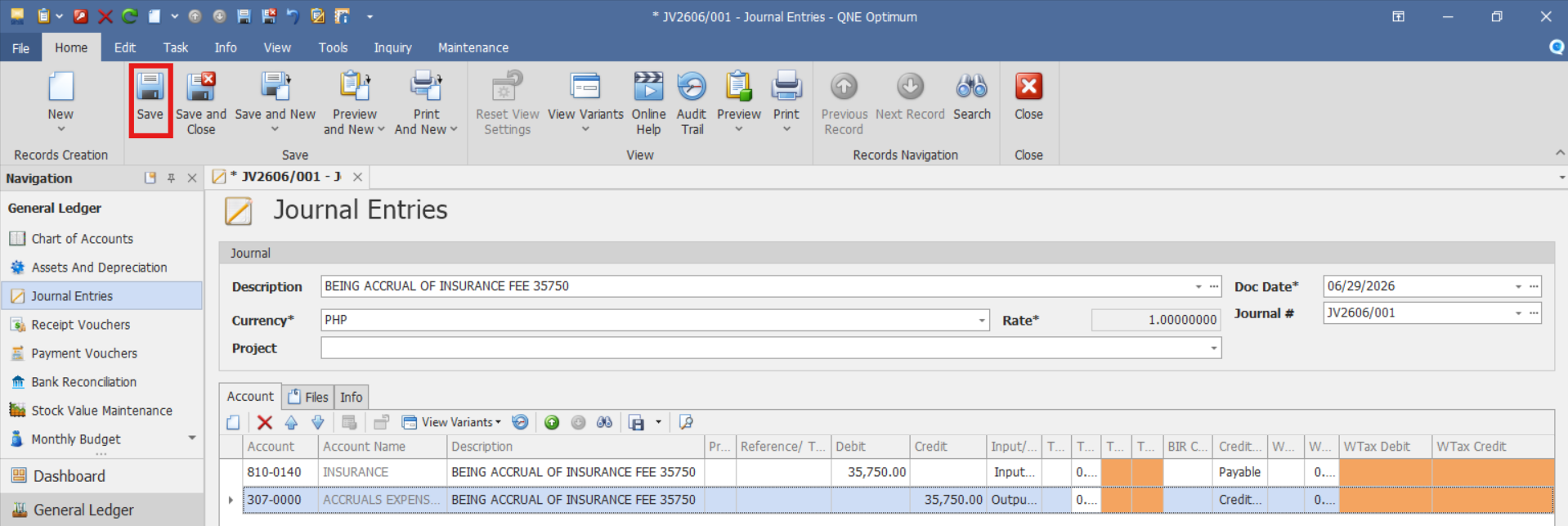
Fill out all the header information needed to create the Journal Entry:
Description
Journal #
Doc. Date (document date in which the Journal Entry will be posted)
Under the Account tab, input the following details:
Account – Select the appropriate ledger account
Description – Enter line description
Ref. No. – Supporting reference (if applicable)
Amount – Enter the allocated amount
Project – Assign if applicable
Tax – Select tax treatment if required
BIR Classification (When Applicable) – Use this field only if the transaction requires tax reporting information.
Not required when:
Recording transactions that do not require tax reporting.
Recording internal accounting adjustments without tax implications.
Recording entries that do not require BIR-related information.
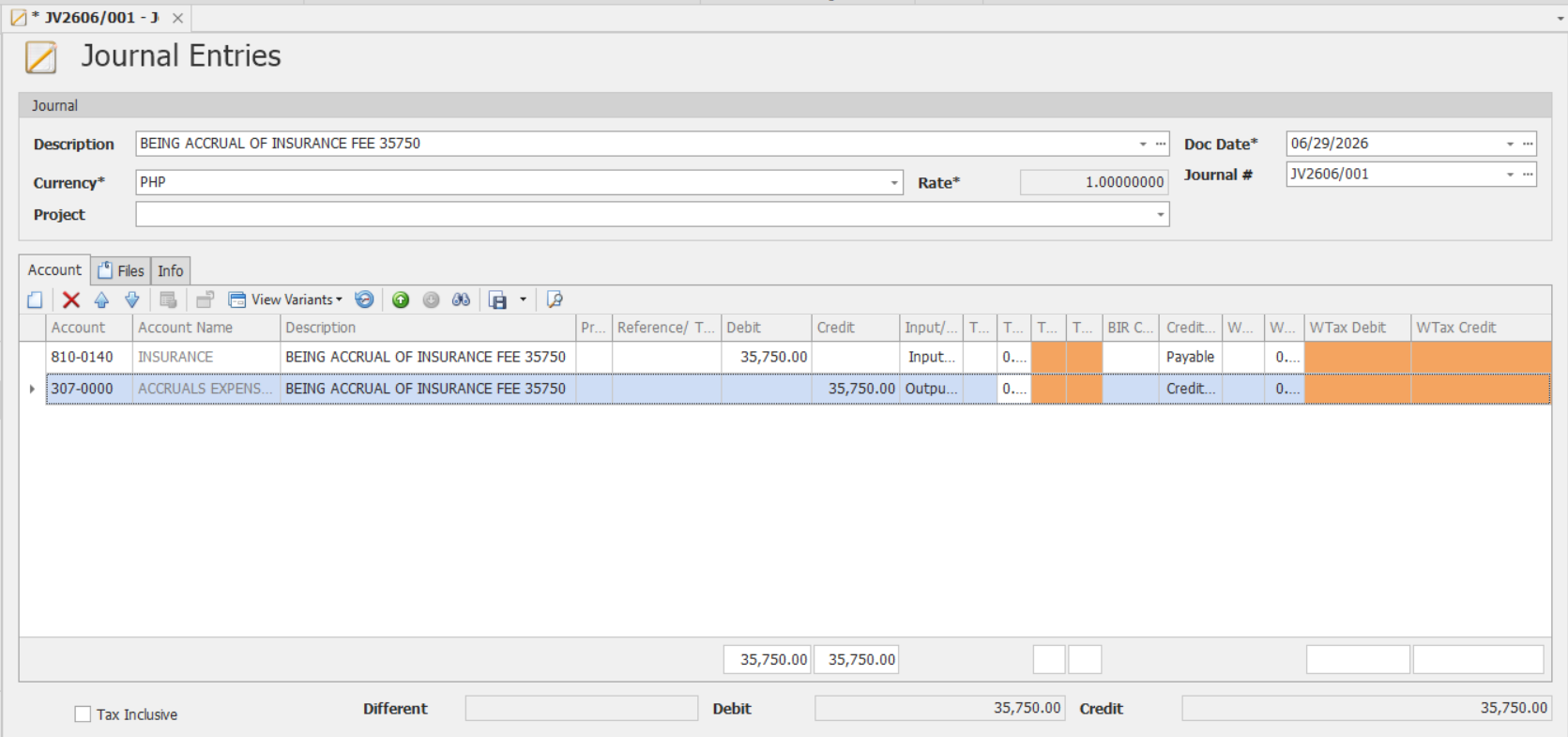
Verify that the total debit amount equals the total credit amount. The system will not allow you to save the transaction if the debit and credit total amount does not tally.
Once done with recording, click Save to record the transaction
Procedure 2: Validation of Recorded Journal Entry
After saving the transaction, verify that:
The journal entry is saved successfully.
The journal entry number is generated or displayed correctly.
The totals reflect the entered amounts, BIR Classification details, VAT and WTax codes (if applicable), and other adjustments.
Verify that the journal entry appears in the Journal Entries List.
Procedure 3: Editing a Journal Entry
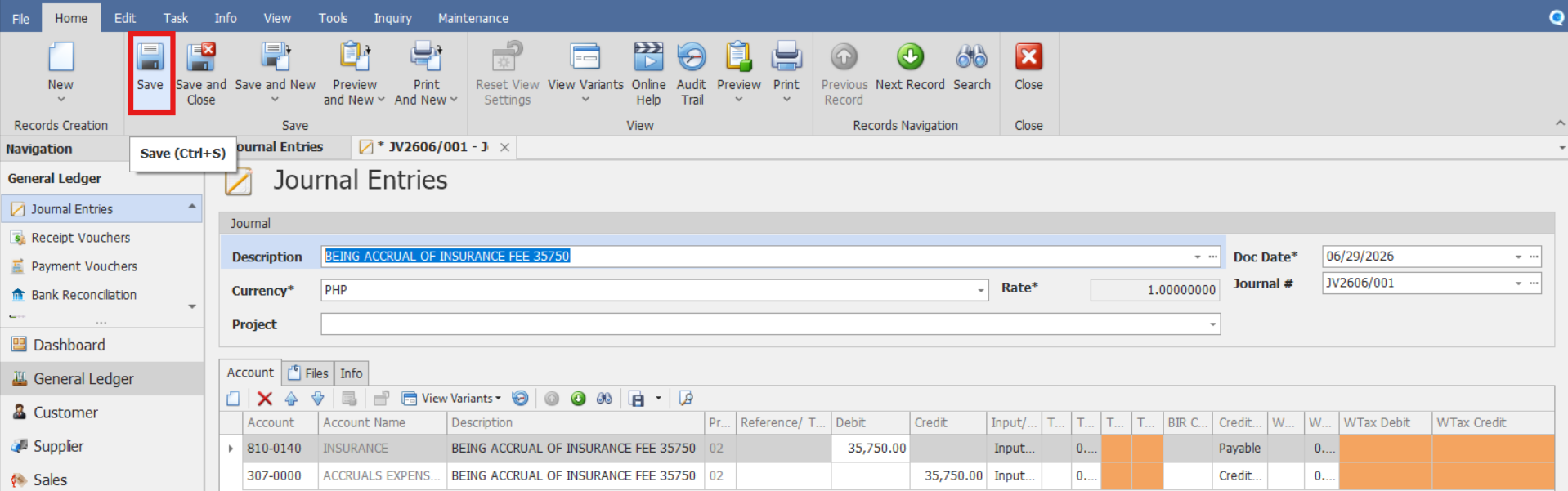
Go to General Ledger > Journal Entries, then select the Doc # of the journal entry that you want to update.

Once opened, make the required changes, then click Save.
Procedure 4: Deleting a Journal Entry
In the Journal Entries List View, identify the document you wish to delete. Hover your cursor over the document and right-click on it. Then click Delete to remove the transaction.

Verify that the Journal Entry no longer appears in the Journal Entries List.
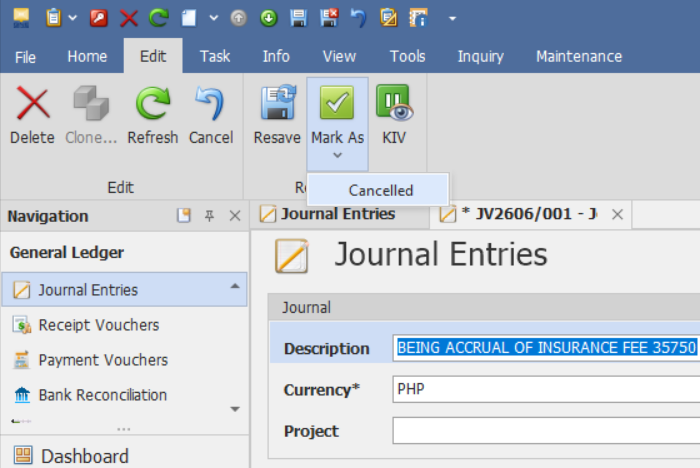
Preferred Method: If the Journal Entry is no longer required, click Cancel instead. This preserves the transaction history while marking it as inactive.
Application (General Use Cases):
Journal Entries in QNE Optimum are commonly used to:
Record month-end and year-end adjusting entries.
Record accruals and prepayments.
Reclassify balances between General Ledger accounts.
Record opening balances during system implementation.
Correct accounting transactions that require manual adjustment.
Record transactions not generated through other system modules.
Important Note:
Editing and Deleting Transactions: Editing and deletion permissions may be restricted based on system configuration, organizational policy, or applicable regulatory requirements (such as CAS approval, where applicable). Ensure modifications and deletions follow your organization's internal policies and applicable regulatory requirements.
Was this article helpful?
That’s Great!
Thank you for your feedback
Sorry! We couldn't be helpful
Thank you for your feedback
Feedback sent
We appreciate your effort and will try to fix the article